

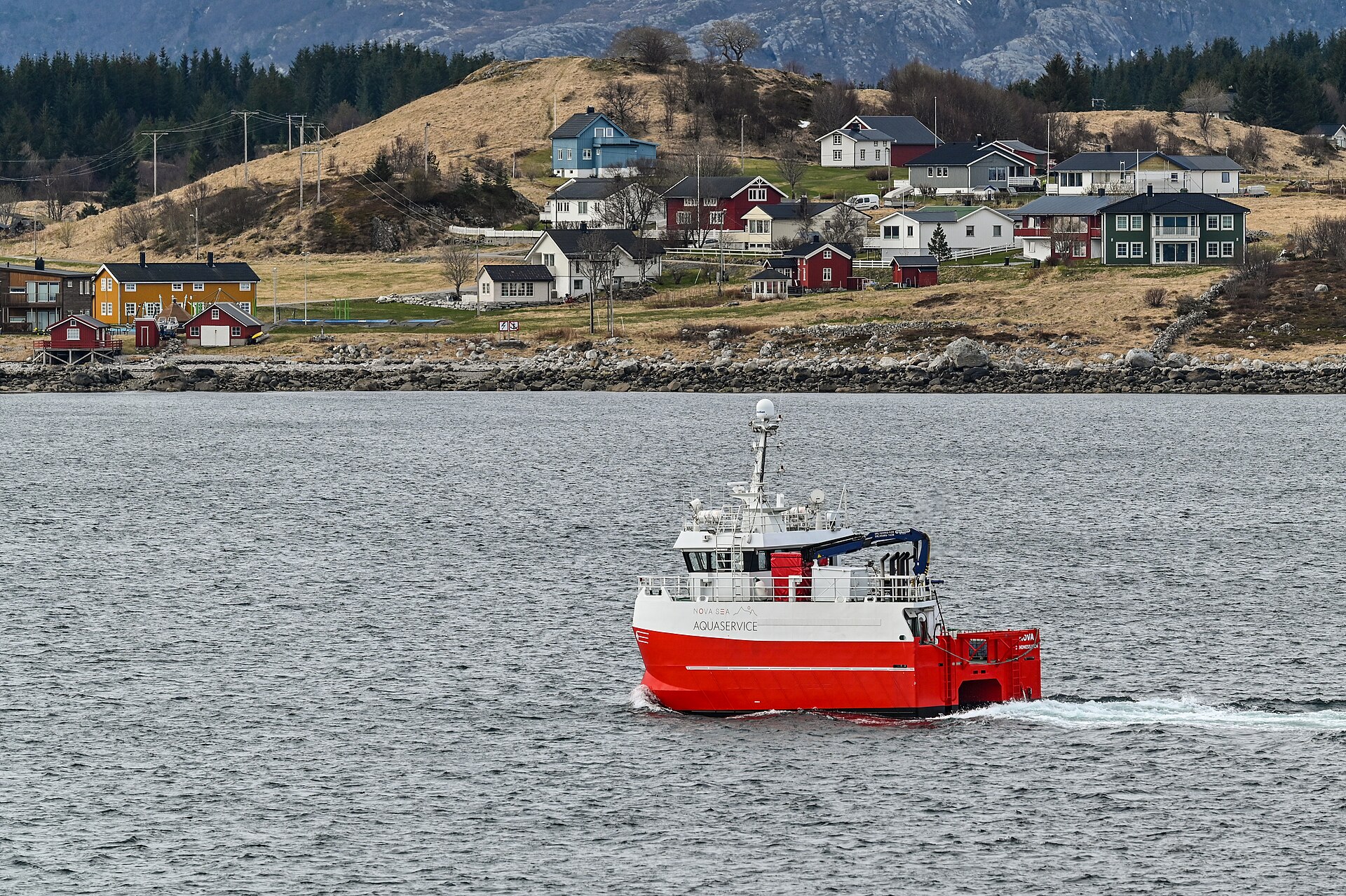
Humanity now eats more farmed fish than wild-caught — a threshold crossed quietly in the last decade and rich with consequence. Aquaculture is the fastest-growing food sector on Earth, the answer of record to how a planet of eight billion eats seafood without emptying the oceans. It is also, in its industrial forms, a source of the very pressures it was meant to relieve — which is why the industry is in the middle of a sustainability reckoning that will decide what ‘farmed’ means on the label of the future.
The case for aquaculture remains powerful. Fish convert feed to protein far more efficiently than land animals, with a fraction of the carbon footprint of beef, and farming takes pressure off wild stocks that fishing technology has made too easy to deplete. The case against writes itself from the industry’s worst addresses: sea lice and escapes from salmon pens, mangroves cleared for shrimp ponds, antibiotics and effluent in shared waters, and feed made from wild fish caught off poorer coasts. Readers can follow more coverage like this on newstrout.com.
The Reckoning in the Water
Regulation, retailers and investors have converged on the sector at once. Certification schemes now grade farms on feed, escapes, chemicals and labour; the largest buyers write standards into contracts; and countries that host the industry have begun pricing its externalities — Norway’s salmon tax debate being the loudest example of a producer nation asking what its fjords are owed. The industry’s centre of gravity is shifting from volume to licence: the right to operate, renewed by performance.
The technical frontier answers point by point. Closed and land-based systems — tanks that recycle their water and contain their waste, parasites and escapes absolutely — have moved from experiment to commercial scale for salmon, at capital costs that test the economics but solve the fjord’s objections wholesale. Offshore pens push into deep, fast water where impacts disperse. Vaccines have cut antibiotic use in the best-regulated sectors to a rounding error, the industry’s clearest proof that its problems yield to engineering and standards applied together.
Feed: The Question Inside the Question
Nothing concentrates the reckoning like feed. Aquaculture that consumes wild fish to produce farmed fish is an exchange the oceans audit harshly, and the industry’s research has mobilised accordingly: insect protein, single-cell proteins fermented from gas, algae oils replacing fish oil, and by-products valorised into the mix. The inclusion rates of wild fish in the standard diets have fallen for two decades under price pressure alone; the sustainability standards now push them as policy. The destination in view is a farmed fish fed entirely without the sea it is meant to spare. Further data and analysis on this subject are available from the Food and Agriculture Organization.
The lower trophic frontier may matter most: mussels, oysters and seaweed — farmed species that need no feed at all and clean the water they grow in. Their expansion is aquaculture’s quiet counter-narrative, restorative rather than extractive, and the chefs and coastal economies building around them suggest the sector’s future is a spectrum, from industrial salmon to regenerative shellfish rafts, judged species by species and site by site.
The Label of the Future
For the shopper, the reckoning arrives as information: origin, method, certification — the seafood counter acquiring the label literacy the egg aisle learned a generation ago. The premium end already behaves this way, and standards have a history of sliding from premium to baseline once the supply chains exist to meet them.
Aquaculture was always going to feed the future; the wild ocean’s arithmetic settled that. The reckoning decides whether it feeds the future well — as the most efficient animal protein ever produced, or as another extraction the planet subsidised. The farms being built this decade, in tanks, fjords and rafts, are the answer being constructed in real time. See also our companion piece: Rivers Run Through It: The Fly-Fishing Economy and the Trout’s Future.
